Factory roof leak repair is not simply about fixing the locations where water drips through. It is a comprehensive process that involves inspecting the roof, identifying the root cause of the leakage, and applying appropriate technical solutions to eliminate the problem effectively.
If the issue is not addressed properly, water will continue to penetrate the roof structure, reducing the building’s service life, damaging machinery and equipment, disrupting production, and resulting in significant repair costs.
So, how is a professional factory roof leak repair process carried out? What technical principles should be followed to ensure long-term performance? Let’s explore the details with Kien Tao Viet in the article below. If your business is experiencing roof leaks in your factory or industrial facility, contact us today at 0936.275.567 or 0906.638.044 for an on-site inspection and the most suitable repair solution.
Why Is It Important to Follow the Correct Factory Roof Leak Repair Process?
Many people believe that simply applying sealant to the area where water is dripping is enough to solve a roof leak. However, in reality, this approach is not effective.
During rainfall, water can travel along the corrugations of the metal roof, structural purlins, or connection joints before eventually dripping onto the factory floor. Therefore, the location where water appears inside the building is often not the actual source of the leak.
Based on practical construction experience, more than 80% of factory roof leaks are not caused by holes in the roofing sheets, but rather by failures at connection points, including:
– Aged EPDM rubber washers on roofing screws.
– Open or damaged overlapping joints between metal roofing sheets.
– Deteriorated waterproof sealant.
– Blocked or leaking gutters.
– Connection points between the roof and walls, skylights, or roof penetrations.
If the root cause is not accurately identified and only the visible leakage is repaired, the problem is likely to recur after just a few heavy rainfalls.
Common Causes of Factory Roof Leaks
Aging Roofing Screws
A factory building with an area of approximately 5,000 m² typically uses between 12,000 and 18,000 roofing screws.
After approximately 10–15 years, the EPDM rubber washers on the screws begin to lose their elasticity due to prolonged exposure to UV radiation and temperature fluctuations.
When as little as 1% of the screws deteriorate, hundreds of potential water infiltration points may develop across the roof.
Thermal Expansion of Roofing Sheets
Steel has a coefficient of thermal expansion of approximately 12 × 10⁻⁶/°C.
For example:
A 20-meter-long roof sheet exposed to a temperature change from 25°C to 70°C can expand by nearly 11 mm. This continuous cycle of expansion and contraction occurs every day and can result in:
– Gradual enlargement of screw holes.
– Deformation of the EPDM rubber washers due to constant compression.
– Loss of watertightness at roof joints.
This is one of the most common reasons why a roof may leak even though the roofing sheets themselves are not punctured.
Improper Roof Sheet Overlap Joints
For roofs with a low slope, if the overlap length is insufficient or the joints are not sealed with specialized waterproof butyl tape, rainwater can be forced back underneath the roofing sheets by strong winds.
Typical overlap lengths are:
– Roof slope above 15°: Approximately 150 mm.
– Roof slope between 10° and 15°: Approximately 200 mm.
– Roof slope below 10°: Recommended overlap of 250–300 mm.
Overloaded Gutters
A factory roof covering 4,000 m² exposed to rainfall with an intensity of 150 mm per hour must be capable of draining approximately 600 m³ of water every hour.
If the gutter system is undersized or blocked by leaves and debris, water will overflow and back up onto the roof, eventually causing leaks.
Corroded, Damaged, or Perforated Roofing Sheets
Metal roofs installed in environments with high concentrations of chemicals, salt-laden air, or elevated temperatures are more susceptible to corrosion.
Once the protective coating deteriorates, water can penetrate directly through rusted areas or perforations in the roofing sheets, resulting in roof leaks.
>> Read more: Mondelez Kinh Do Office Renovation Project by Kien Tao Viet
Professional Factory Roof Leak Repair Process at Kien Tao Viet
To ensure long-term performance, Kien Tao Viet follows a systematic roof leak repair process based on strict technical procedures.
Step 1. Information Collection and On-Site Inspection
Our engineering team gathers essential information, including:
– When the roof leak first occurred.
– Weather conditions under which the leak appears.
– The affected areas.
– The service life of the factory roof.
– The type of roofing material.
Afterward, a comprehensive on-site inspection of the entire roof is carried out.
Step 2. Comprehensive Roof Inspection
Rather than inspecting only the visible leak locations, our engineers evaluate the entire roofing system, including:
– 100% of the metal roof area.
– All roofing screws.
– Roof sheet overlap joints.
– Ridge caps.
– Flashings.
– Skylights.
– Gutters.
– Roof penetrations.
– The roof drainage system.
Any abnormalities are identified, photographed, marked, and documented to develop an appropriate repair plan.
Step 3. Root Cause Identification
Following the inspection, the causes of the roof leaks are classified into the following categories:
– Material deterioration.
– Construction defects.
– Design deficiencies.
– Structural deformation.
– Natural aging.
Accurately identifying the root cause allows the most suitable repair solution to be selected instead of relying on temporary fixes.
Step 4. Develop an Appropriate Factory Roof Leak Repair Solution
Depending on the actual condition of the roof, Kien Tao Viet combines multiple repair methods, including:
– Replacing deteriorated roofing screws with new screws fitted with EPDM rubber washers.
– Reinforcing roof joints with Butyl waterproof tape.
– Applying PU sealant or MS Polymer sealant to gaps and joints.
– Replacing corroded or severely damaged roofing sheets.
– Repairing gutters and improving the roof drainage system.
– Applying waterproof roof coatings when necessary.
– Reinforcing the roof structure in areas affected by sagging or deformation.
Combining multiple repair methods ensures a long-lasting solution rather than a temporary repair.
Step 5. Factory Roof Leak Repair Execution
During the repair process, our technical team strictly follows industry standards by:
– Thoroughly cleaning the roof surface before application.
– Avoiding installation on wet or dusty surfaces.
– Using only genuine, high-quality waterproofing materials.
– Applying the correct screw tightening torque to prevent damage to the EPDM rubber washers.
– Reinforcing all locations that may become potential leak points in the future.
Step 6. Final Inspection and Project Handover
Upon completion, the repaired roof is tested using a water spray test or monitored under actual rainfall conditions.
The project is accepted and handed over to the client only after every repaired area has met the required quality standards.
Key Principles of Effective Factory Roof Leak Repair
A factory roof leak repair project can only achieve long-term performance when the following technical principles are strictly followed.
Address the Root Cause
Roof leaks should not be repaired based solely on the location where water drips inside the building.
Instead, it is essential to identify the actual path of water infiltration and determine the true source of the leak before carrying out any repairs.
Use High-Quality Materials
Standard household silicone sealants are not suitable for industrial factory roofs.
The following materials are recommended: PU Sealant, MS Polymer Sealant, Professional-grade Neutral Silicone Sealant, High-quality EPDM rubber washers.
Apply Waterproofing Materials on a Properly Prepared Surface
Waterproof sealants can only achieve optimal performance when applied to surfaces that are: Clean, Dry, Free from oil and grease, Free from rust and corrosion.
Do Not Overlook Critical Connection Points
In addition to the visible leak locations, all potential leakage points should be inspected and repaired simultaneously, including: Roofing screws, Roof sheet overlap joints, Gutters, Flashings, Skylights.
These are the areas with the highest risk of water infiltration on factory roofs.
Safety Regulations for Factory Roof Leak Repair
Factory roof leak repair involves working at height. Therefore, strict safety regulations must be followed throughout the repair process:
– Inspect the roof structure before commencing any work.
– Do not perform repair work during rain or strong winds.
– Wear a full-body safety harness at all times.
– Use certified lifelines and properly installed anchor points.
– Wear non-slip safety footwear and a safety helmet.
– Walk only on the roof purlins and never step directly on the middle of the metal roof panels to avoid deformation or damage.
– These safety requirements not only protect workers but also help prevent additional damage to the roof during the repair process.
>> Read more: Cafeteria Renovation Project for Mondelez Kinh Do Vietnam by Kien Tao Viet
Conclusion
Factory roof leak repair is far more than simply applying sealant or replacing a few roofing screws. It is a systematic process that involves roof inspection, root cause analysis, selecting the appropriate materials, and carrying out repairs in accordance with established technical procedures. Only by addressing the root cause of the problem can long-lasting waterproofing performance be achieved while minimizing the risk of future leaks.

Blog mới nhất
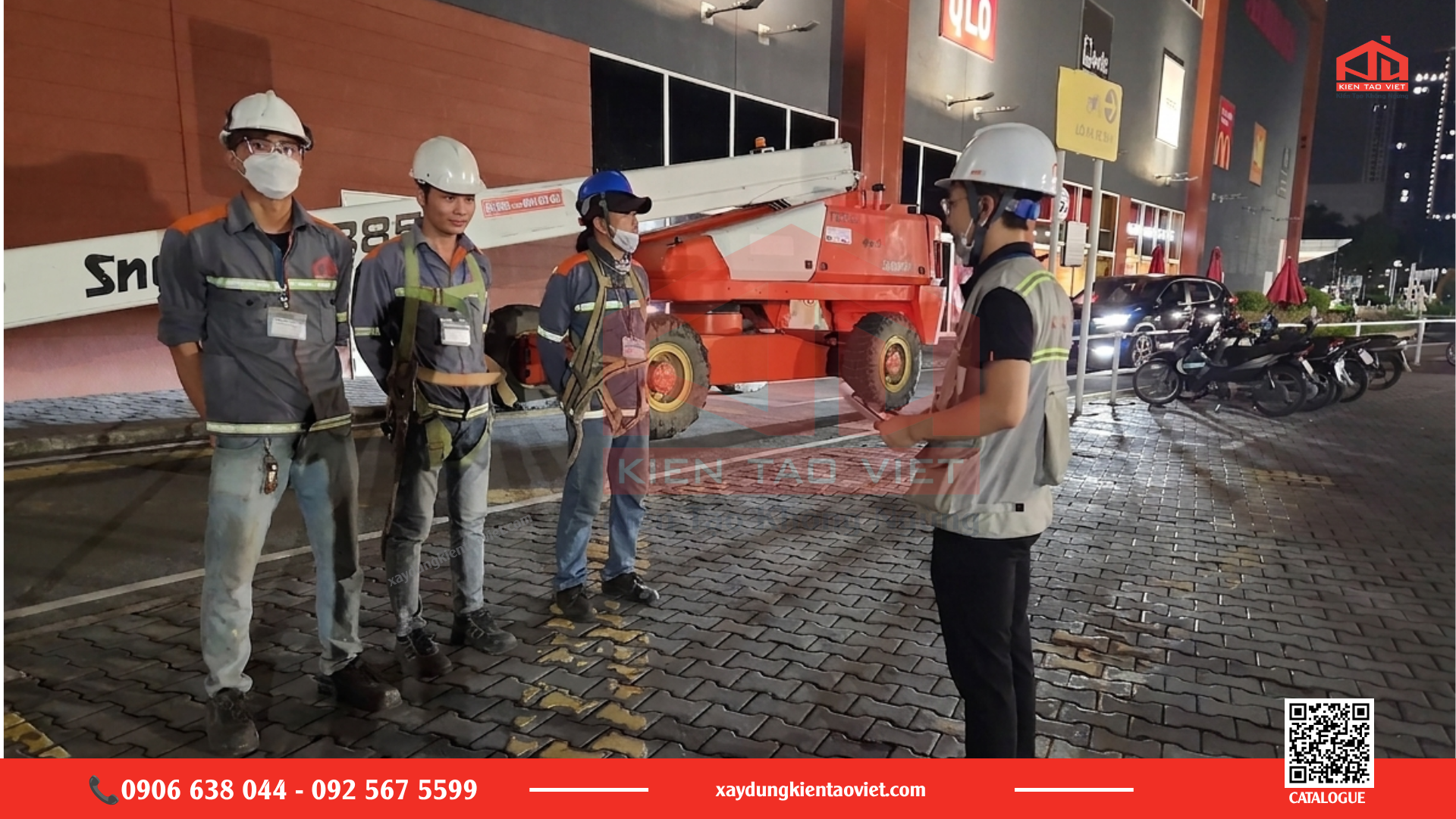
Hồ sơ an toàn nhà thầu: Chuẩn bị gì trước khi thi công tại nhà máy?
Hồ sơ an toàn nhà thầu cần thể hiện công việc sẽ làm, người chịu trách nhiệm, mối nguy đã nhận diện và biện pháp kiểm soát tương ứng. Doanh nghiệp nên xác định yêu cầu hồ sơ theo phạm vi thi công và điều kiện cơ sở, thay vì sử dụng một bộ tài […]
Kế hoạch cải tạo hạ tầng nhà máy theo từng giai đoạn
Kế hoạch cải tạo hạ tầng nhà máy nên xác định rõ hiện trạng, nhu cầu vận hành, mức độ ưu tiên và điều kiện triển khai của từng hạng mục. Doanh nghiệp cần thống nhất phạm vi, ngân sách, lịch phối hợp với sản xuất và tiêu chí bàn giao trước khi huy động […]

Thi công bảng hiệu nhà máy tại TP.HCM | Kiến Tạo Việt
Thi công bảng hiệu nhà máy cần bắt đầu từ vị trí lắp đặt, mục đích nhận diện và điều kiện tiếp cận công trình. Doanh nghiệp nên chốt nội dung, kích thước, vật liệu, phương án chiếu sáng, trách nhiệm lắp đặt và tiêu chí nghiệm thu trước khi gia công. Một thiết kế […]

Chi phí cải tạo văn phòng: Cách lập dự toán và kiểm soát phát sinh
Chi phí cải tạo văn phòng không thể xác định chính xác phân tích chính xác. Doanh nghiệp cần biết hiện trạng mặt bằng, các hạng mục phải làm, vật liệu lựa chọn và điều kiện tổ chức thi công. Một báo giá hữu ích phải thể hiện khối lượng, cung cấp phạm vi, loại […]

Cải Tạo Văn Phòng Tại Củ Chi Trọn Gói
Nhiều nhà máy và kho bãi tại Củ Chi đang gặp tình trạng văn phòng cũ thiếu diện tích, bố trí bất hợp lý, hệ thống kỹ thuật xuống cấp. Cải tạo văn phòng tại Củ Chi giúp doanh nghiệp tận dụng mặt bằng sẵn có, tái cấu trúc công năng, tiết kiệm thời gian […]
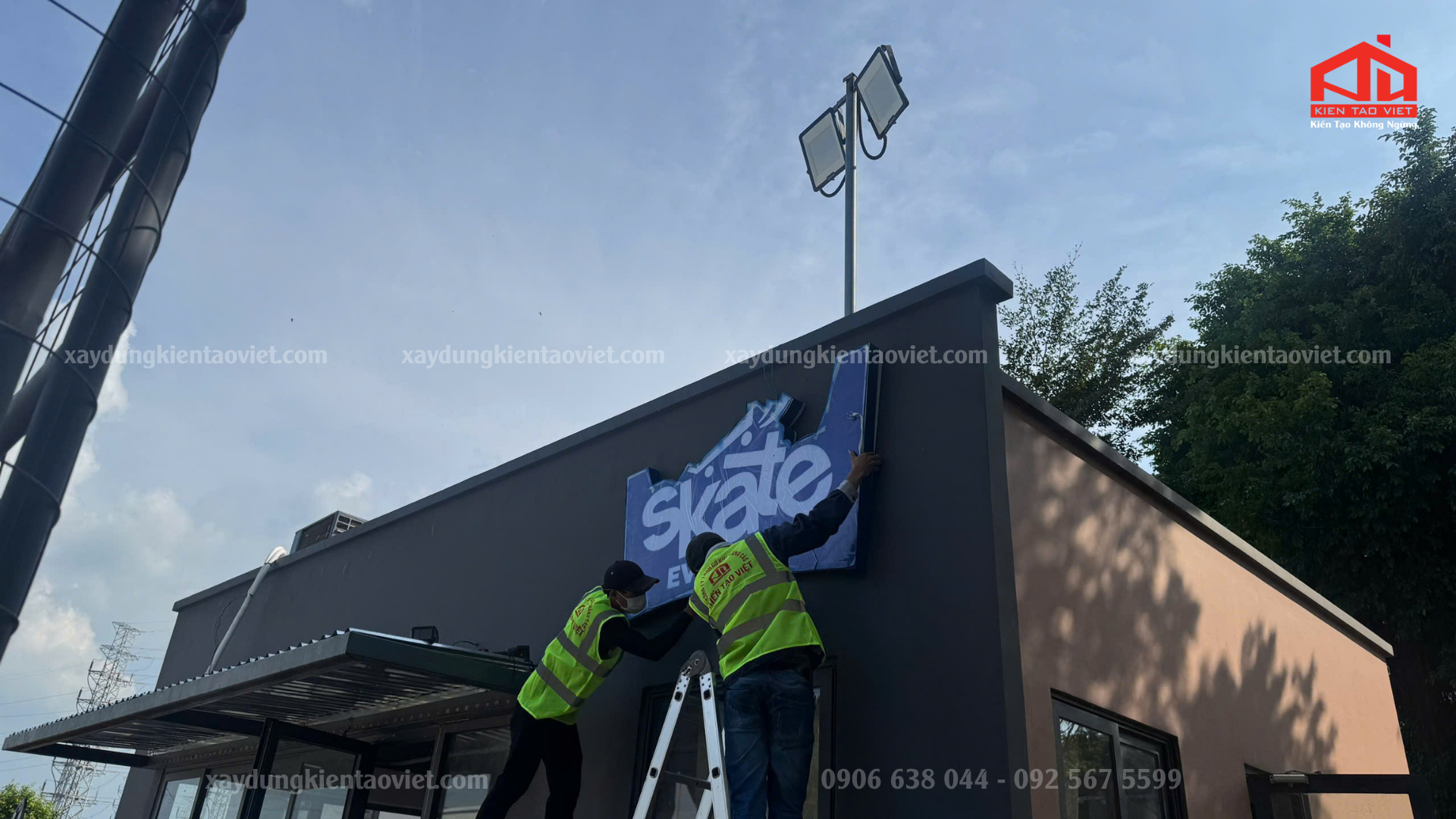
An toàn lắp đặt bảng hiệu trên cao: Doanh nghiệp cần phối hợp những gì?
An toàn lắp đặt bảng hiệu trên cao cần được chuẩn bị trước khi huy động đội thi công. Doanh nghiệp và nhà thầu phải làm rõ vị trí, cách tiếp cận, nhân sự, thiết bị, hoạt động bên dưới và điều kiện triển khai. Phương án phải do người có chuyên môn xem xét; […]
-
Vì sao lắp đặt mái che di động trở thành xu hướng những năm gần đây
-
Những điều cần biết về lắp đặt mái che di động 2026
-
Những điều cần biết khi chọn nhà thầu xây dựng nhà thép tiền chế 2026
-

07 Tiêu chí chọn nhà thầu xây dựng – cải tạo nhà xưởng uy tín 2026
-

Cải tạo văn phòng doanh nghiệp 2026: Những điều cần biết